The DGCA Exam Tips Nobody Gives You Before Your First Paper
Every DGCA guide tells you to read IC Joshi and practise lots of questions. Fine, you should. But nobody mentions that you get nothing to write on in Met, that changing an answer takes three clicks, or that one badly timed fail can cost you a whole session. This is that stuff.
Ready Aviator · 22 October 2026
The screen and the hall
If a senior told you the software makes you wait 15 seconds on every question, that was true until late 2025. It's gone now.
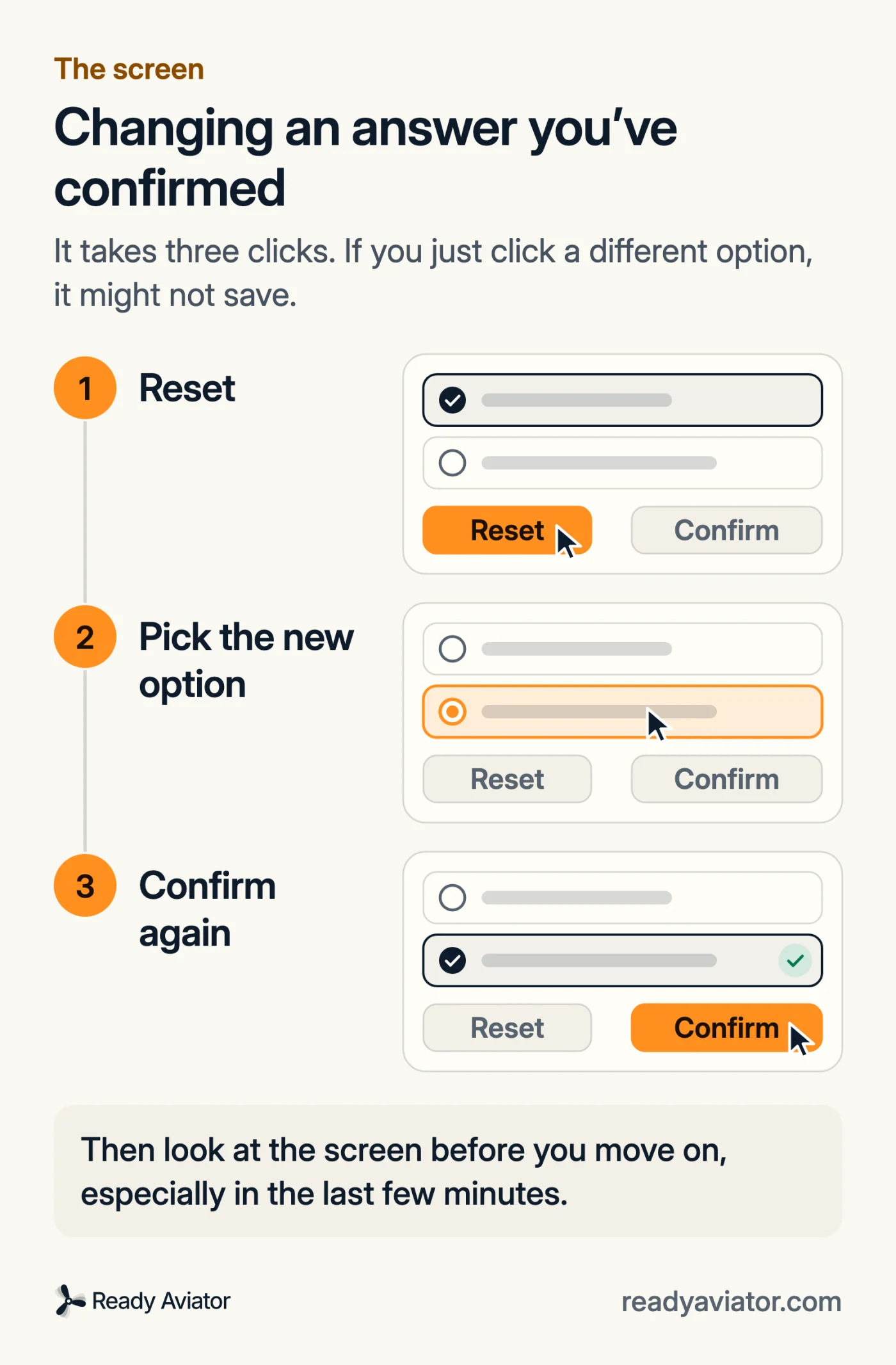
What hasn't gone is the slightly annoying way you change an answer. Once you've confirmed one, hit Reset, pick the new option, then Confirm again. If you just click a different option, it might not save, and you'll only find out when the result comes. Look at the screen before you move on, especially when you're racing back through the paper in the last few minutes.
You only get rough sheets in Navigation. Ask for as many as you like; they collect them at the end. In Met, Regs and the Technical papers there's nothing to write on, so the small Met sums like ISA deviation and altimeter errors have to happen in your head. Practise them that way at home.
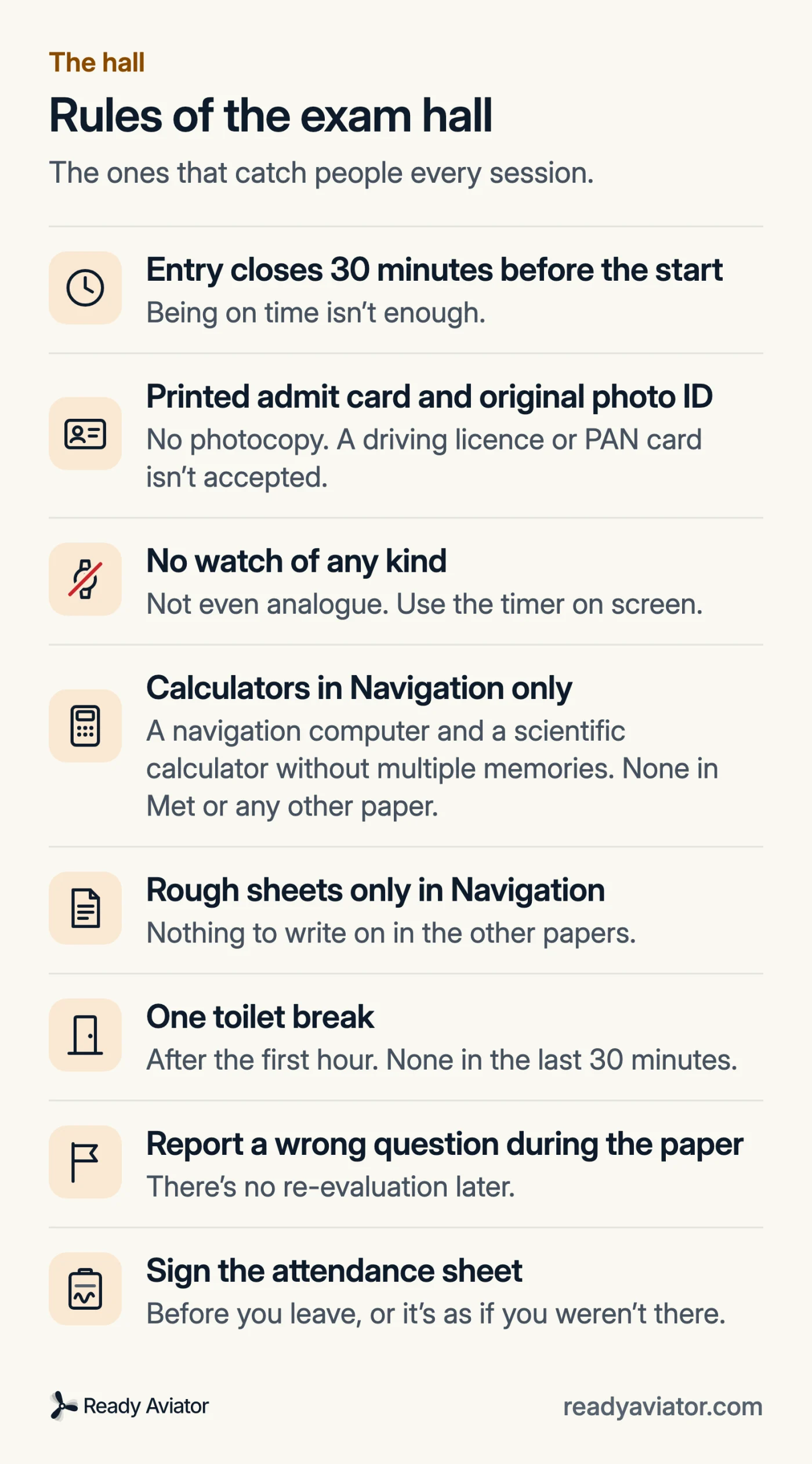
Calculators follow DGCA's rule. In Navigation you can take a navigation computer and a scientific calculator without multiple memories. In Met and every other paper, nothing (CAR Section 7, Series B, Part I, para 8.5). Whatever anyone in your batch claims, you can't take one into Met.
A few hall rules catch people every session:
- No watch of any kind, not even a plain analogue one. Use the timer on screen.
- One toilet break, and only after the first hour. None in the last 30 minutes.
- Sign the attendance sheet before you leave, or it's as if you weren't there.
- Think a question is wrong? Report it during the paper on the form they give you. There's no re-evaluation later.
And get there early. Entry closes 30 minutes before the paper starts, so being on time isn't enough. Bring a printout of your admit card, in colour if you can, and your original photo ID. A photocopy won't do, and a driving licence or PAN card isn't on the accepted list.
Sort your CX-3 out weeks before Navigation
Every session, someone is begging their group for a CX-3 three days before the paper. Don't be that person. Buy or borrow one early, actually learn it, and put fresh batteries in the night before.
The best trick with it is working backwards. For crosswind limits, wind velocity, drift or a unit conversion, don't solve from scratch. Punch each option into the wind page and keep the one that works. It's a few quick checks and you're done.
What each paper is really like
Met is mostly IC Joshi. A big chunk of the paper looks a lot like the end-of-chapter questions, so do every one of them. But read the chapters too, because some sittings drift well away from the book. Indian weather comes up constantly: the monsoon, western disturbances, cyclones. If you only have time to polish a few topics, make them icing, fronts, fog and mountain waves.
For Regs, RK Bali is where everyone starts. Get the latest edition, because the rules keep changing. How much of the paper comes straight out of the book depends a lot on which shift you get, so don't just memorise answers; know the rule behind them. And don't leave out human performance. It turns up far more than you'd think.
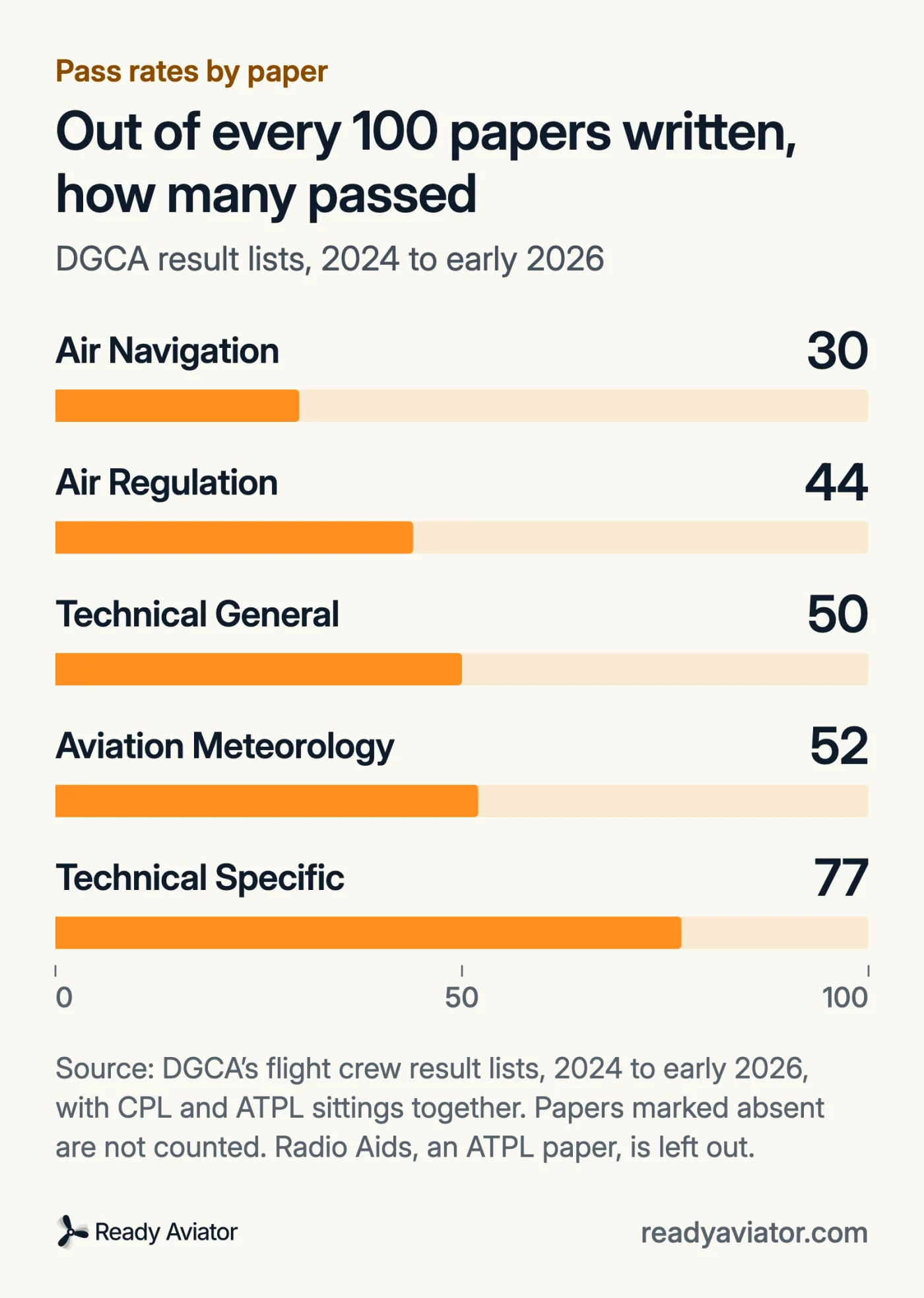
Navigation is RK Bali and Oxford for the theory, Keith Williams for practice. It's also the CPL paper that fails the most people: in DGCA's own result lists from 2024 to early 2026, only about 30 in every 100 Navigation papers written were a pass. You'll have roughly 100 questions in three hours, so speed matters as much as knowing the method. CP and PNR, mass and balance, the flight plan, charts and projections, ADF and VOR, compass and variation, and V speeds are where most of the marks are.
Technical General is Oxford plus a good question bank. A lot of it repeats from sitting to sitting, so this is the paper where grinding through questions pays off most.
Technical Specific is your aircraft's operating handbook and a question bank. It's the easiest of the five: in the same result lists, about 77 in every 100 were a pass.
Booking, and the 42-day trap
Regular sessions don't run out of seats, so there's no need to stay up the night booking opens. On-demand (OLODE) sessions are different. Seats are first come, first served, and Delhi and Mumbai go first. If your city shows full, keep checking until the window closes. Seats come back during the window, often at odd hours.
People also love to say OLODE papers are harder. They aren't. Difficulty changes from shift to shift in any session, so prepare for the hard version either way.
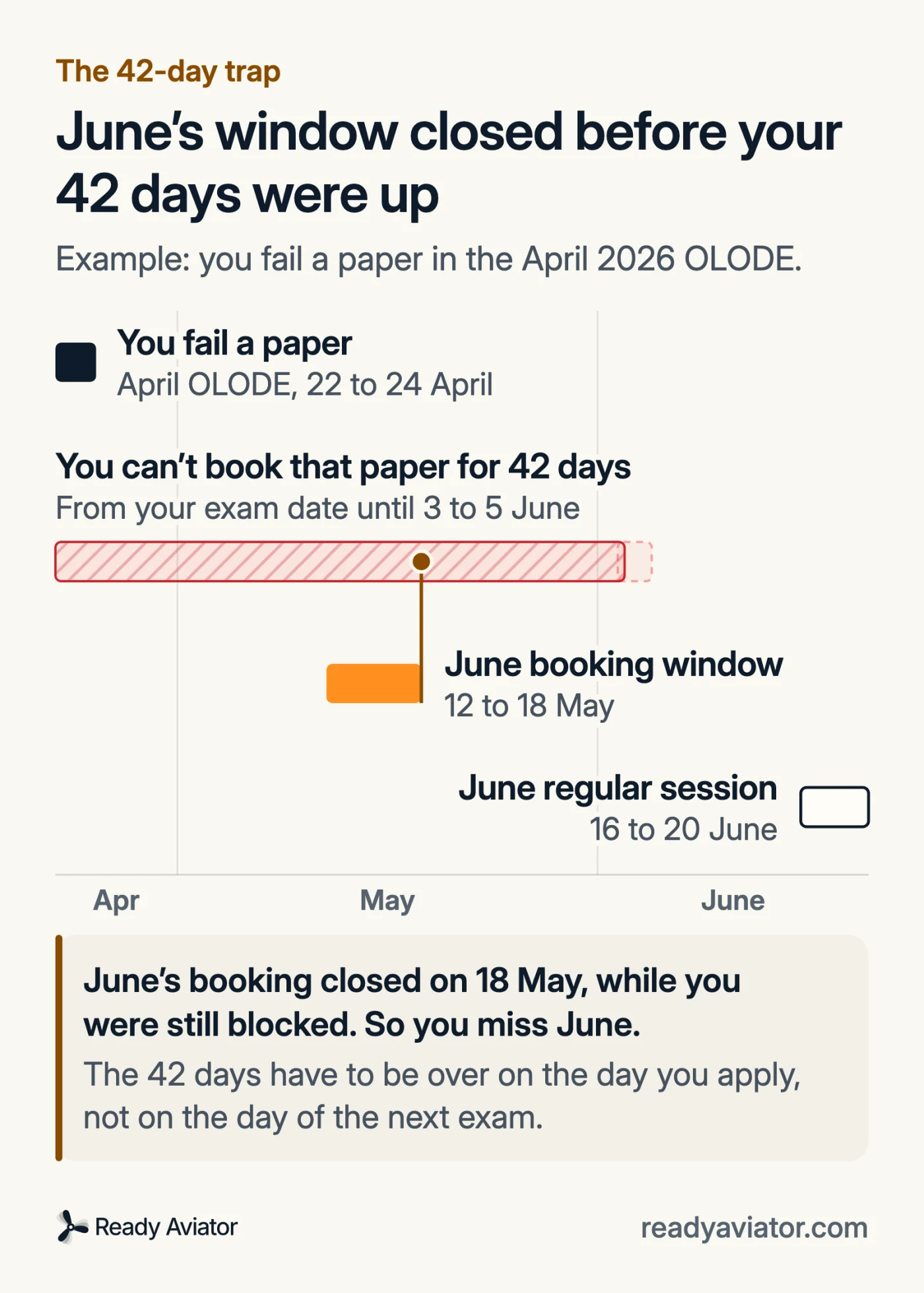
Now the trap. If you fail a paper, you can't rebook that paper for 42 days from your exam date. Your other papers aren't affected. Most people know that much. What catches them out is that the 42 days have to be over on the day you apply, not on the day of the next exam. Fail in the April 2026 OLODE (22 to 24 April) and you'd have missed June's regular session, because June's booking window closed on 18 May, before your 42 days were up. Plan your papers with that in mind.
And no, the 42-day rule hasn't been scrapped. There was a rumour in September 2026, but people were still being blocked in October. Skipping a paper you booked doesn't start it, though you may have to wait until the results mark you absent before you can book again.
Results day
You'll usually hear first through an SMS from NIELIT with a provisional score. It goes out in batches and some people never get one, so a missing SMS doesn't mean you failed. Your real result is in your own Pariksha login; since July 2026 that's the only place DGCA shows it.
And ignore the result screenshots flying around your groups. Fake ones show up every single time.
The RTR practical
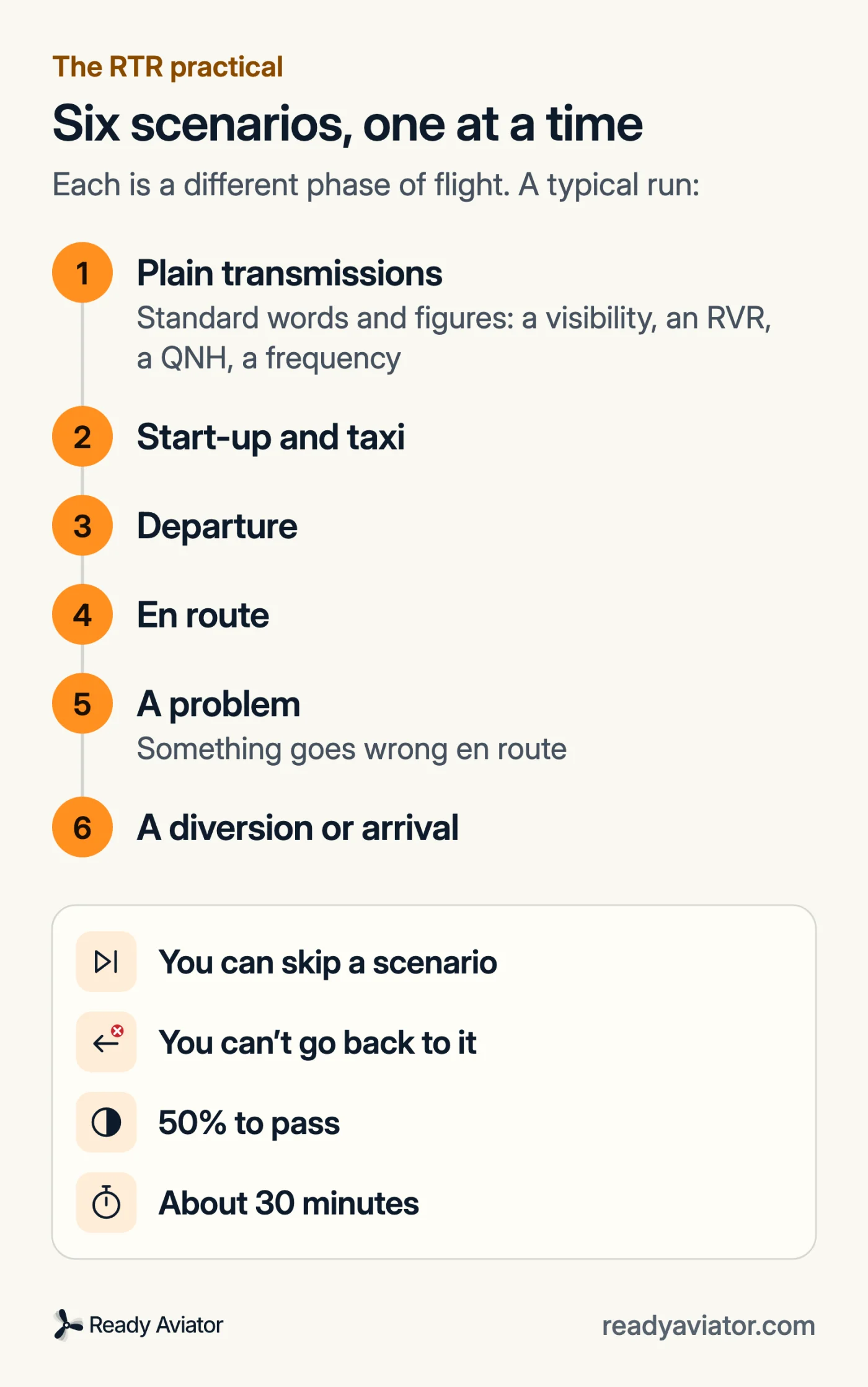
DGCA has run the RTR practical since January 2026. It's about 30 minutes, with six scenarios, each a different phase of flight, shown one at a time. You can skip a scenario but you can't go back to it. You need 50% to pass, and you get three attempts while your written pass is valid. Unlike the CPL papers, not turning up for a booked practical uses up one of those attempts, and if you fail, you can't sit it again for six weeks.
A few things that help on the day:
- It often starts gently, with plain transmissions in standard words and figures: a visibility, an RVR, a QNH, a frequency.
- The scenarios follow a flight. You start up and taxi, then depart, and then something goes wrong en route, often ending in a diversion. A blocked taxiway, birds on the runway, an engine that won't start, a sick or unruly passenger and an engine fire are all fair game.
- You get paper, so write long clearances down before reading them back. Some examiners pick up the pace once you're coping well, so don't count on having time to write everything.
- Keep an eye on the scenario panel. It changes while your head is down.
- Read the whole screen before your first call. Nerves cost people this exam far more often than not knowing the phraseology.
Somewhere to practise all of this
Ready Aviator has DGCA questions for every CPL subject, each with a full worked solution, free with an account. There's also a list of the questions that come up most often in the DGCA exams. The top 10 in each subject are free, and the full list, sorted by topic, comes with Pro.
Sign up for freeKeep reading
Practise by subject